
This year could be the perfect opportunity to sell your home. Here’s why: According to a recent survey by NerdWallet, 15% of people plan to purchase a home in 2025, marking a record high for this particular survey (see the graph below):
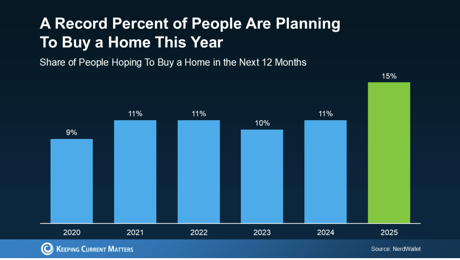
Why is this such a significant finding? The percentage of buyers has remained between 9-11% since 2020, so this notable increase signals that demand hasn’t disappeared. If anything, it suggests there’s a pent-up demand ready to re-enter the market.
That doesn’t mean we’ll see the kind of frenzy we experienced a few years ago. But, it does indicate more activity than we saw in 2024.
Some buyers who had previously postponed their plans are now ready to take action. Whether it’s because they feel more confident about moving, have saved up enough for a down payment, or can’t wait any longer — they’re making their move this year.
According to the same NerdWallet survey, more than half (54%) of these prospective buyers have already started browsing homes online. This is a strong indicator that many will be searching during the peak homebuying season this spring. If you partner with the right agent to prepare, price, and market your home effectively, you can ensure it gets in front of these buyers.
What does this mean?
More people are planning to move this year. With the right strategy, your home can be one of the first they consider.
What features do you think these buyers will love most about your home? Connect with an agent to discuss your home’s potential and how to make it stand out in your listing.
You might have heard recent discussions about the economy and talk of a potential recession. It’s no surprise that such conversations may cause some concern about a housing market crash. You might even be wondering if it’s something to worry about. But here’s the good news – there’s no need to panic. The current housing market isn’t set up for a crash.
Real estate journalist Michele Lerner explains:
“A housing market crash happens when home values plummet due to a lack of demand for homes or an oversupply.”
With that definition in mind, here are two key reasons why a housing market crash is unlikely:
- Demand for Homes Outpaces Supply
One of the major contributors to the 2008 housing crash was an oversupply of homes. Today, however, the situation is quite different.
Typically, when the supply and demand for homes are balanced, there’s about a six-month supply of homes. A higher number means there are more homes than buyers, while a lower number signals demand exceeds supply. The graph below shows where things stand today, using data from the National Association of Realtors (NAR):
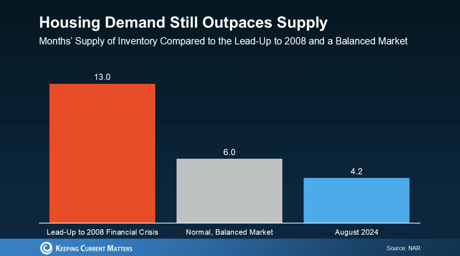
The red bar represents 13 months of supply before the 2008 housing crisis, which was an excess. The gray bar shows a balanced market with six months of supply, for context. And the blue bar reflects the current market with just 4.2 months of supply.
In short, more people are looking to buy than there are homes available to purchase. So, demand is exceeding supply. When this happens, home prices tend to stay steady or even rise — the opposite of a housing market crash.
It’s also important to note that inventory levels can vary depending on the location. Some markets may be more balanced, while others may have a slight oversupply, affecting local prices. However, the majority of markets are still facing a shortage of homes.
Lawrence Yun, Chief Economist at NAR, explains:
“We simply don’t have enough inventory. Will some markets see a price decline? Yes. [But] with the supply not being there, the chance of a 30 percent price drop is highly, highly unlikely.”
- Unemployment Remains Low
In 2008, high unemployment rates contributed to many homeowners struggling to make mortgage payments, which led to foreclosures and a surge of homes flooding the market. Today, the employment situation is much more stable (see graph below):
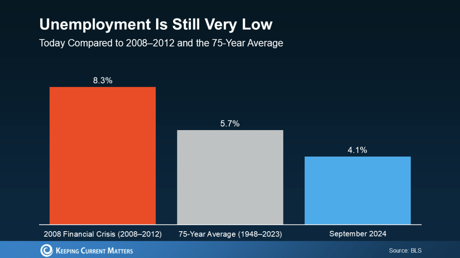
The red bar represents the 2008 financial crisis with unemployment at 8.3%. The gray bar shows the 75-year average of 5.7%, and the blue bar shows today’s unemployment rate at just 4.1%.
Currently, people are employed, earning an income, and able to make mortgage payments. This helps prevent the type of foreclosure wave we saw in 2008. Plus, the strong job market means more people are in a position to buy homes, which keeps demand high and continues to put upward pressure on prices.
Today’s Housing Market is Stronger than in 2008
While concerns about a potential recession and economic uncertainty are understandable, rest assured that today’s housing market is in a much stronger position than it was in 2008. As Rick Sharga, Founder and CEO of CJ Patrick Company, states:
“Literally everything is different about today’s housing market dynamics than the conditions that led to the housing crisis.”
With demand for homes still surpassing supply and unemployment remaining low, the conditions that caused the 2008 crash are not present today.
Bottom Line
The housing market today is in a much healthier position than it was in 2008. However, real estate is a local market, and conditions vary from place to place.
To stay informed about how these factors are impacting your area, it’s always a good idea to reach out to a local real estate agent. If you’re considering selling your home, now could be the perfect time to talk to an expert about your specific market. Contact us at 949-444-1601 to find out more.