You’ll find our blog to be a wealth of information, covering everything from local market statistics and home values to community happenings. That’s because we care about the community and want to help you find your place in it. Please reach out if you have any questions at all. We’d love to talk with you!
The supply of homes available to purchase today is at an all-time low level, and it is matched with strong demand that is not much different than prior to the pandemic. As a result, the market has been white hot from day one of 2022. It is an unprecedented start to the year that is without comparison.
As the inventory dropped, housing has grown hotter and hotter. We started the first of the year with only 1,100 properties (houses, condos, townhomes) available to purchase in Orange County, an unmatched, ultra-low home supply that shattered the prior record low achieved in January 2021, at 2,633 homes. Last year’s start crushed the 2013 record start of 3,161 homes. The active inventory had been dropping prior to COVID, but the pandemic further disrupted housing and intensified the inventory crisis. The crisis had evolved into a catastrophe by the end of 2021 as the fewest number of homes come on the market in December and the second fewest in November. That set up the unprecedented start to this year.
When the inventory is this low, just about everything that is placed on the market is thrown into escrow after being exposed to the marketplace for less than a week. As a result, the Expected Market Time (the time between hammering in the FOR-SALE sign to opening escrow) started this year at 25 days, shattering last year’s record 42-day start. At 42 days, Orange County housing is a Hot Seller’s Market (less than 60 days).
At 25 days, it is an Insane Seller’s Market (less than 30 days) where buyers trip over each other to see every home that enters the fray, sellers call the shots, multiple offers and bidding wars are the norm, and home values are skyrocketing. (For perspective, we have to reach 90 days on market for it to be a balanced market and 120 days on market for the tide to turn to a buyer’s market.)
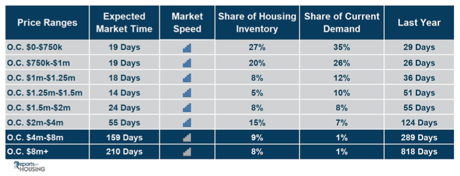
As the market time reaches lower and lower levels, falling further below the 30 day “insanity” mark, there are more showings, more multiple offers, and higher sales prices. With nearly nothing on the market, home values are soaring, and today’s higher mortgage rates are not deterring buyers from purchasing.As you can see below, the most demand is in the $1.25million to $1.5million range in Orange County with the expected market time at just 2 weeks!
When it comes to demand, we typically quantify that by the number of current pending sales. But with such low inventory, we can't accurately gauge just how much actual buyer demand there is because so many buyers are just waiting for more homes to come on the market.
The moral of the story: if you have been thinking of selling, there is no better time than RIGHT NOW!
Foreclosures and Short-Sales
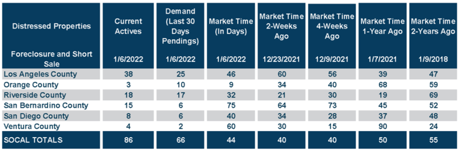
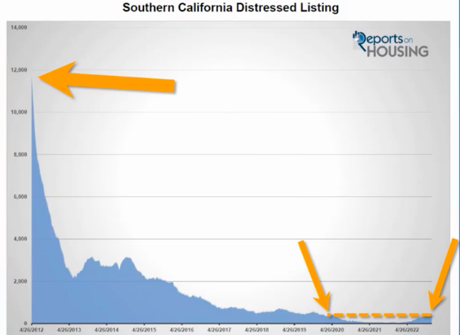
In 2020 and 2021, fear-mongering analysts argued that there would be an influx of foreclosures and short sales as a result of the pandemic and forbearance. But as you can see in the chart below, to the great dismay of buyers, they just haven’t materialized.
What Does this Mean for You?
Whether you are a buyer, seller, or renter, understand that like everything else these days, rent and the purchase price of a property is going to continue to go up. And while I don’t have a crystal ball (but I sure wish I did, Crypto currency), price increases are likely to continue through 2022 and into 2023.
One of the major reasons there is such low inventory is because homeowners don’t know where to go with so few homes on the market. Naturally, the hope of any seller is that they will find their next house, put in an offer that is contingent upon selling their current house, then put their home on the market and have them both close escrow around the same time. In this market, contingent offers aren’t really considered - not when sellers have multiple non-contingent and all-cash offers. The key is to develop a plan and strategy. The Swan Team can help you with that.
BUYERS: Waiting for the market to get easier is not the answer.
Home values are on the rise and mortgage rates have been on the rise as well. Values are slated to climb between 8 to 10% in Orange County, and mortgage rates could reach or even exceed 3.5%.With rising values and higher rates, payments increase, and home affordability will slowly erode. Waiting is not an option. You will need to make sure you have realistic expectations and understand that patience is key. Not to mention, working with a realtor or team who knows how to get offers accepted is paramount. {Hint, hint: The Swan Team!}
SELLERS: Take advantage of the hot market by pricing a home as close to the last comparable or pending sale.
Carefully pricing will allow you to tap into the throngs of buyers waiting for every home that hits the market. A realistic price will allow you to attract a ton of offers. The bidding war that follows will allow you to obtain a very high sales price, typically selling for a lot higher than the asking price. But you can’t be arrogant and overprice your property. That will lead to fewer showings and fewer (if any) offers.
When it comes to listing your home, it isn’t just as easy as putting a sign up in front of the house. There is planning and work that needs to be done to ensure you get the most return on your investment, the highest sales price possible AND the most convenient terms for you (ie. when you move out, potential rent back, repairs, etc.).
That is where The Swan Team comes in. We are here to make the process the most profitable, convenient, and stress-free it possibly can be. If you or a loved one are thinking about selling, please contact us. We are here to help answer any questions and are happy toshare our strategies and plan for your success.
Contact us today by simply clicking on the phone icon at the top of the screen. Or you can always dial us at 949-444-1601 or email us at info@theswanteamoc.com.
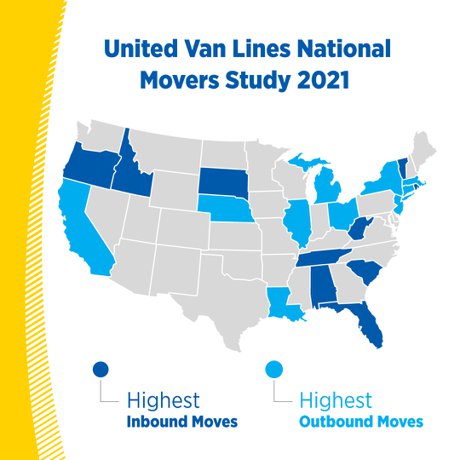
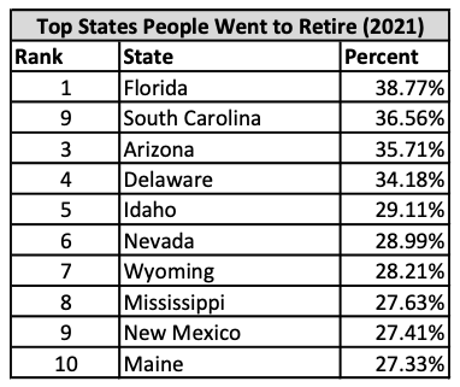
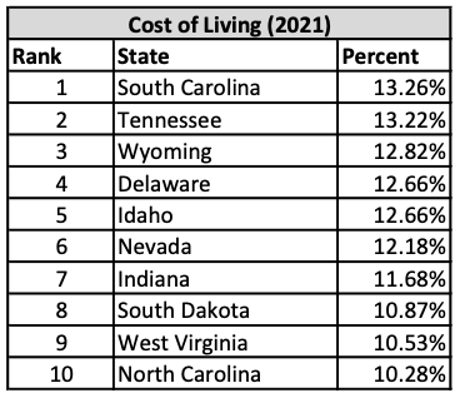
United Van Lines just revealed their National Movers Study for 2021 based on their exclusive data of customers' state-to-state migrations.
What states did people leave the most?
It's not surprising that people left New Jersey, Illinois, New York, California and Connecticut at the highest rates - likely because of the high cost of housing and high tax burdens.
What states did people move to the most?
Vermont, South Dakota, South Carolina, West Virginia, and Florida topped the list.
Here's the big question: would you prefer to live in the state people are most leaving or the state people are moving to??
Living in Orange County, we are so lucky to be so closed to "the Happiest Place on Earth," a.k.a. Disneyland. When you visit Disneyland, you quickly realize there are many people that really really love Disney - so much so that Disney has decided to build a Disney community in Southern California.
That's right. The creative team behind Disney theme parks, Walt Disney Imagineering has announced they will be designing a master-planned community in Rancho Mirage (Palm Springs area) called Cotino. The community will feature estates, single-family homes, and condos as well as an "oasis" with a beach park, nearby dining and entertainment, and a hotel.
The community will have a section built just for residents 55 and older and will feature recognizable Disney charm its fans have come to love including Disney cast members. Residents of Cotino will have the option of a club membership which will include access to live shows, cooking classes, and wellness activities as well as its clubhouse, beach activities and water activities.
Walt Disney Imagineering has partnered with DMB Development, which specializes in large planned communities, to build and create Cotino.
To learn more about Cotino and see renderings of the future community, Click Here.
The story for real estate hasn't changed much in the past month: We still have too many buyers and not enough homes available for them to buy.
Which leads to many questions:
How long will this supply shortage last? When will prices start leveling off?
When will prices start dropping?
What about short sales and foreclosures now that people can no longer claim forbearance?
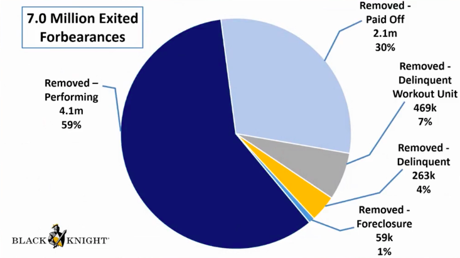
While we don't have a crystal ball about exact dates (and anyone who says they do is just guessing), we do have definitive data about forbearances and potential foreclosures/short sales.
To begin with, as you will see in the chart above, 7 million forbearances have been removed - and only 1% nationwide is going to result in actual foreclosure. Why only 1%? Because in the time that people claimed forbearance, home values have increased at a higher rate than what they owe.
Let's take a home that was purchased at $750,000. In the past year and a half, the value of the house has increased by 20%, making it now worth $900,000. Even if the homeowner didn't make their mortgage payment for a year, the roughly $36,000 that they owe for those missed mortgage payments is still less than the $150,000 the homeowner has made in value. So the homeowner is still ahead by roughly $110,000. The homeowner is not in the same situation as 2009 when they hadn't made mortgage payments in a year and the value of the property had dropped by $100,000+.
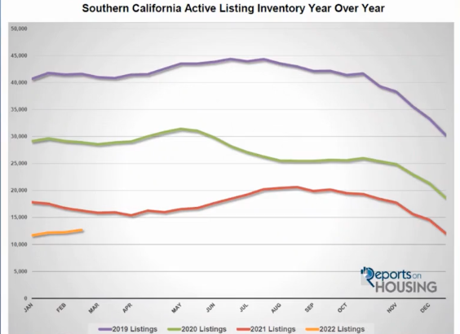
Having said all of that, there will be more foreclosures and shorts sales this year. How many exactly are we expecting? Only approximately 500 short sales or foreclosures are coming on the market in Southern California this year which definitely will not make up for the 30,000 homes missing from the market since 2019.
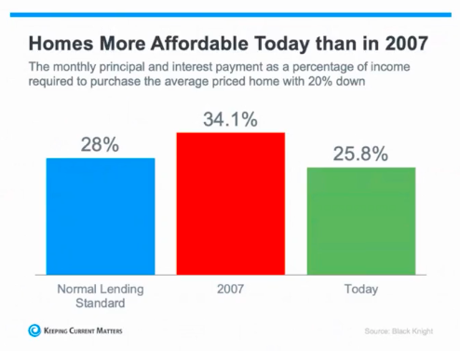
This lack of inventory has undoubtedly led to many frustrated buyers. Even with home prices continuing to increase and interest rates hovering around 4% now, buyers are not deterred. It seems unfathomable to many on just how buyers can afford the sky-rocketing home prices. But the truth is, homes are more affordable today than they even were back in 2007.
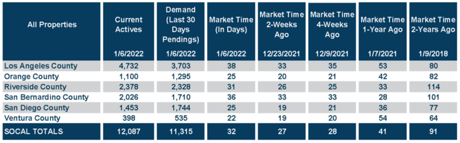
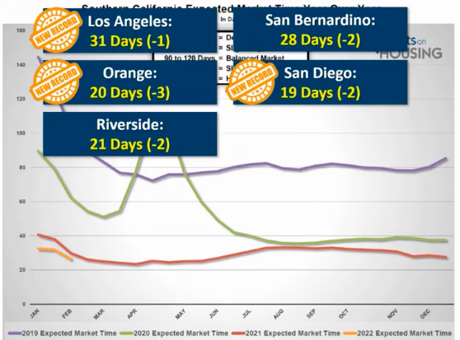
With inventory incredibly low and demand still insanely high, homes are continuing to sell faster and faster. The current average time on market for a property in Southern California is 25 days, which is just 1 day less than this time last year (26 days).The 3-year average days on market is 69 days.
As you will see in the chart below, the average days on market from going active on MLS to going under contract has hit record lows in LA, Orange and San Diego counties. It takes 3 weeks or less to sell a home in Orange, San Diego and Riverside counties, and essentially 4 weeks in Los Angeles and San Bernardino counties.
To put things in perspective, the average days on market will have to hit 90 days for prices to plateau. Days on market would have to hit 120 days for prices to start dropping. What does that mean if you are a buyer? We are nowhere near at the peak of the market and now is still a great time to purchase a home not only for its utility but also as an investment.
For sellers, this lack of inventory means they are still calling the shots with multiple offers (most well over asking price), free rent back offers, escrow closing quickly, and perhaps not making a single repair.
What to expect for the rest of 2022
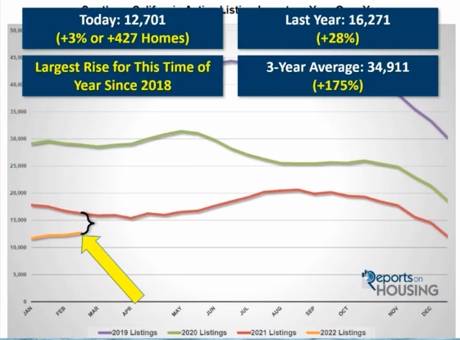
Home prices and values are going to continue to increase in 2022. We won't see any changes to the market until supply starts to increase. If we were to compare the market supply to a faucet right now, we are at a very slow drip. Believe it or not, this slow drip is actually better than the flow of new listings in January - which was was bone dry. We have actually seen the largest rise in inventory this time of year since 2018 and anticipate that the flow of new listings will be at a steady trickle as we approach late March and April.
Bottom Line: There has never been a better time to buy or sell Orange County real estate. As all of us who live in Orange County know, we get a much better bang for our buck than those living in LA or the San Francisco Bay Area. (That is why so many people are moving from those areas to Orange County.) The proximity to beaches, moderate weather, high-paying jobs and lower levels of homelessness, makes Orange County a semi-hidden jewel of California.
So whether you are looking to buy or sell a home in Orange County, The Swan Team is here to make the process the most profitable, convenient, and stress-free it possibly can be. If you or someone you know is thinking about buying or selling, please contact us. We are here to help answer any questions as well as strategize and plan for your success.
Contact us today by simply clicking on the phone icon at the top of the screen or you can call us at 949-444-1601.
Based on the Primary Mortgage Market Survey from Freddie Mac, the average 30-year fixed-rate mortgage has increased by 1.2% (3.22% to 4.42%) since January of this year. The rate jumped by more than a quarter of a point from just a week ago. Here’s a visual to show how mortgage rate movement throughout 2021 was steady compared to the rapid increase in mortgage rates this year:
Just a few months ago, Freddie Mac projected mortgage rates would average 3.6% in 2022. Earlier this month, Fannie Mae forecast mortgage rates would average 3.8% in 2022. As the chart above shows, rates have already surpassed those projections.
Sam Khater, Chief Economist at Freddie Mac, explained in a press release last week:
“This week, the 30-year fixed-rate mortgage increased by more than a quarter of a percent as mortgage rates across all loan types continued to move up. Rising inflation, escalating geopolitical uncertainty and the Federal Reserve’s actions are driving rates higher and weakening consumers’ purchasing power.”
Where Are Mortgage Rates Going from Here?
In a recent article by Bankrate, several industry experts weighed in on where rates might be headed going forward. Here are some of their forecasts:
Greg McBride, Chief Financial Analyst, Bankrate:
“With inflation figures continuing to surprise to the upside, mortgage rates will remain above 4.0% on the 30-year fixed.”
Nadia Evangelou, Senior Economist and Director of Forecasting, National Association of Realtors (NAR):
“While higher short-term interest rates will push up mortgage rates, I expect some of this impact to be mitigated eventually through lower inflation. Thus, I expect the 30-year fixed mortgage rate to continue to rise, although we aren’t likely to see the big jumps that occurred over the past few weeks.”
Len Kiefer, Deputy Chief Economist, Freddie Mac:
“Mortgage rates are likely to continue to move higher throughout the balance of 2022, although the pace of rate increases is likely to moderate.”
In a recent realtor.comarticle, another expert adds to the conversation:
Danielle Hale, Chief Economist, realtor.com:
“. . . As markets digest the Fed’s updated economic projections, I anticipate a continued increase in mortgage rates over the next several months. . . .”
What Does This Mean for You if You’re Looking To Buy a Home?
With both mortgage rates and home values expected to increase throughout the year, it would be better to buy sooner rather than later if you’re able. That’s because it’ll cost you more the longer you wait. But, there is a possible silver lining to buying a home right now. While you’ll be paying a higher price and a higher mortgage rate than you would have last year, rising prices do have a long-term benefit once you buy.
If you purchase a home today valued at $400,000 and put 10% down, you would be taking out a $360,000 mortgage. According to mortgagecalculator.net, at a 4.42% fixed mortgage rate, your mortgage payment would be $1,807 a month (this does not include insurance, taxes, and other fees because those vary by location).
Now, let’s put that mortgage payment into a new perspective based on the substantial growth in equity that comes with the escalation in home prices. Every quarter, Pulsenomics surveys a panel of over 100 economists, investment strategists, and housing market analysts about their expectations for future home prices in the United States. Last week, Pulsenomics released their latest Home Price Expectation Survey. The survey reveals that the average of the experts’ forecasts calls for a 9% increase in home values in 2022.
Based on those projections, a $400,000 house you buy today could be valued at $436,000 by this time next year. If you break that down, that means the equity in your home would increase by $3,000 a month over that period. That’s greater than the estimated monthly payment above. Granted, the increase in your net worth is tied to the home, but it is one way to put the home price appreciation to use in a way that benefits you.
Bottom Line
Paying a higher price for a home and a higher mortgage rate can be a difficult pill to swallow. However, waiting will just cost you more. If you’re ready, willing, and able to buy a home, now will be a better time than a year, or even six months from now. Let’s connect to begin the process today.
Call us at 949.444.1601 or email info@theswanteamoc.com to learn more about the options available to you and to make your real estate goals and dreams a reality.
As rates zoom upwards, home affordability is beginning to impact the housing market in several profound and meaningful ways.
The scent of orange tree blossoms is captivating. It is just the beginning of the slow metamorphosis from flower to fruit. After the flower blooms, it takes navel oranges seven to 12 months to mature. It is far from instant, but as the petals drop, it reveals a tiny, green fruit that will eventually become a juicy, ripe orange.
Similarly, the evolution of the housing market is far from instant. It does not change like a snap of the fingers. Higher rates are like the orange blossom, just the beginning of a slow metamorphosis from an insane, out-of-control housing market to a slower, more balanced, normal housing market. It takes time, but new trends are already emerging.
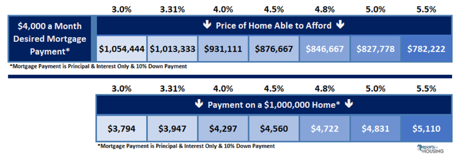
1.Rapidly rising rates mean affordability has taken a dramatic hit so far this year. According to the Mortgage Bankers Association®, interest rates have risen from 3.31% on December 29th to 4.8% on March 30th, representing a 45% increase. The purchasing power for buyers has rapidly eroded in such a short period of time. For a buyer looking to put 10% down and desiring a $4,000 per month payment, at the end of December they were looking at a $1,013,333 home. Today, that same buyer is now looking at homes just below $850,000. Another way of looking at it is how much more the payment is on a $1 million home. At 3.31% with 10% down, the payment would be $3,947 per month versus $4,772 per month at 4.8% today. That is an additional $884 per month, or $10,608 per year. Persistent higher rates will eventually diminish demand and, ultimately, throttle back the housing market. The pool of buyers able to purchase shrinks as rates rise.
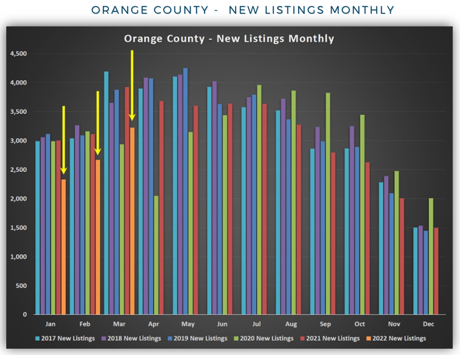
2. Significantly fewer homes are being placed on the market this year compared to the average prior to COVID. Last year there were 2,368 missing FOR-SALE signs in Orange County compared to the 3-year average between 2017 to 2019, 6% less. Yet, through the first three months of 2022, there are 1,866 missing signs, down 18%. Originally, the extremely anemic inventory was preventing homeowners from entering the fray. Today, it is more than that. Owners are more than happy staying put in their homes. They are acutely aware that home values are continuing to rise, that mortgage rates have substantially climbed, and that the underlying mortgage loan on their home is substantially lower than today’s 4.8% rate. In doing the math, homeowners are opting to stay put. Many homeowners who purchased several years back have refinanced to below 3% and have realized substantial appreciation. Yet in calculating their monthly mortgage payment and property taxes if they sell and purchase a larger home, the monthly difference can be staggering. As a result, many homeowners are opting to stay.
3. Demand, a snapshot of the number of new escrows over the prior month, has been substantially muted this year. Today’s demand is at 2,286 pending sales. So far this year demand has risen from 1,295 during the first week of January to 2,286 today, an increase of 991 pending sales. The 3-year average rise in demand prior to COVID (2017 to 2019) was 1,277, or 29% higher than today. Last year’s demand reading was at 3,162 pending sales, 38% higher than today. Today’s level is the lowest reading to start the 2nd quarter of a year since 2007. Demand has been muted all year. A big reason for muted demand readings is the acute lack of homes available to purchase. Simple economics: “You cannot buy what is not for sale.” True demand, the number of buyers in the marketplace, is considerably higher than tracked demand based upon escrow activity, yet is impossible to gauge other than home showing activity and the number of offers generated on homes today. Anecdotally, reports from the real estate trenches detail a reduction in the number of multiple offers real estate agents are receiving. Over time, if mortgage rates persist at these higher levels with duration, then demand will continue to remain muted compared to prior years even with more homes coming on the market. It is important to note that the strongest demographic patch of first-time home buyers ever, millennials, is making its way through the real estate market right now. The surge of prime first-time home buyers aged 32 years old occurs between 2020 and 2024. That demographic was added on top of an increase in buyer activity during COVID thanks to record low mortgage rates. Those record rates are gone, but there are still an astonishing number of millennials contributing to demand.
The Orange County housing market has been running at an insane pace since July 2020. Yet, with mortgage rates climbing from 3.31% at the end of December to 4.8% today, new trends have emerged that will ultimately lead to a market downshift as long as higher rates endure.
In Summary
The active listing inventory decreased by 2 homes, nearly unchanged, and now totals 1,552 homes, its lowest level for this time of the year since tracking began 18 years ago. In March, there were 18% fewer homes that came on the market compared to the 3-year average prior to COVID (2017 to 2019), 685 fewer. Last year, there were 2,240 homes on the market, 688 additional homes, or 44% more.
Demand, the number of pending sales over the prior month, increased by 2 pending sales in the past two weeks, nearly unchanged, and now totals 2,286. Last year, there were 3,162 pending sales, 38% more than today, and the peak for demand in 2021. The 3-year average prior to COVID (2017 to 2019) was 2,668, or 17% more.
With supply and demand unchanged, the Expected Market Time, the number of days to sell all Orange County listings at the current buying pace, remained unchanged at 20 days in the past couple of weeks, an insanely Hot Seller’s Market (less than 60 days). It was at 21 days last year, similar to today.
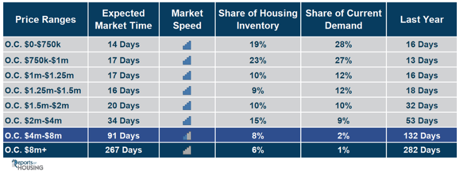
With the exception of homes priced between $750k-$1.25m, the expected market time is shorter than this time last year. Homes priced between $1.5m-$4m have seen the biggest drops in expected market time. (See the chart below for details)
The luxury end, all homes above $2 million, accounts for 29% of the inventory and 12% of demand.
Distressed homes, both short sales and foreclosures combined, made up only 0.2% of all listings and 0.2% of demand. There are only 3 foreclosures and no short sales available to purchase today in all of Orange County, 3 total distressed homes on the active market, up 1 from two weeks ago. Last year there were 8 total distressed homes on the market, similar to today.
There were 1,774 closed residential resales in February, 22% less than February 2021’s 2,283 closed sales. February marked a 2% drop compared to January 2022. The sales to list price ratio was 103.7% for all of Orange County. Foreclosures accounted for just 0.2% of all closed sales, and short sales accounted for 0.3%. That means that 99.5% of all sales were good ol’ fashioned sellers with equity.
If you would like more information or are interested in selling or buying a property, please call 949.444.1601 or email info@theswanteamoc.com.
The Market is starting to shift...but how? Watch Leslie explain the status of the Canyon Crest Estates market specifically as well as giving an overall market update.
See for yourself what is going on in the Canyon Crest market:
With inventory in Canyon Crest at zero and people chomping at the bit for a home in our beautiful community, NOW is a great time to sell your home.
Striking while the iron is hot is key to your success; just as working with the right real estate team is paramount to selling it quickly and for top dollar. That is where The Swan Team comes in!
Our team doesn't merely market, list and sell your home. We are consultants who help you understand your options, help create a plan that accounts for your particular wants and needs and then execute the plan with a precision that exceeds your expectations.
Contact me now and get the best team in the business working for you! (You can click the phone icon or the envelope at the top left of your screen, too!)
Experts in the real estate industry use a number of terms when they talk about what’s happening with home prices. And some of those words sound a bit similar but mean very different things. To help clarify what’s happening with home prices and where experts say they’re going, here’s a look at a few terms you may hear:
Appreciation is when home prices increase.
Depreciation is when home prices decrease.
Deceleration is when home prices continue to appreciate but at a slower pace.
Where Home Prices Have Been in Recent Years
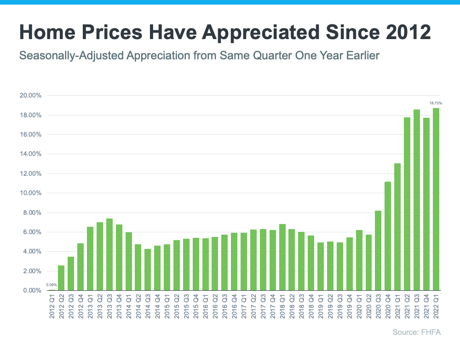
For starters, you’ve probably heard home prices have skyrocketed over the past two years, but homes were actually appreciating long before that. You might be surprised to learn that home prices have climbed for 122 consecutive months (see graph below):
As the graph shows, houses have gained value consistently over the past 10 consecutive years. But since 2020, the increase has been more dramatic as home price growth accelerated.
So why did home prices climb so much? It’s because there were more buyers than there were homes for sale. That imbalance put upward pressure on home prices because demand was high and supply was low.
Where Experts Say Home Prices Are Going
While this is helpful context, if you’re a buyer or seller in today’s market, you probably want to know what’s going to happen with home prices moving forward. Will they continue that same growth path or will home prices fall?
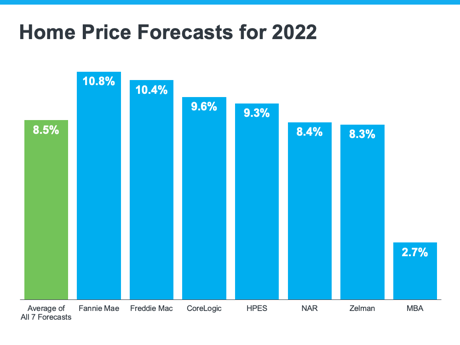
Experts are forecasting ongoing appreciation, just at a decelerated pace. In other words, prices will keep climbing, just not as fast as they have been. The graph below shows home price forecasts from seven industry leaders. None are calling for prices to fall (see graph below):
Mark Fleming, Chief Economist at First American,identifies a key reason why home prices won’t depreciate or drop:
“In today’s housing market, demand for homes continues to outpace supply, which is keeping the pressure on house prices, so don’t expect house prices to decline.”
And although housing supply is starting to tick up, it’s not enough to make home prices decline because there’s still a gap between the number of homes available for sale and the volume of buyers looking to make a purchase.
Terry Loebs, Founder of the research firm Pulsenomics, notes that most real estate experts and economists anticipate home prices will continue rising. As he puts it:
“With home values at record-high levels and avast majority of experts projecting additional price increases this year and beyond, home prices and expectations remain buoyant.”
Bottom Line
Experts forecast price deceleration, not depreciation. That means home prices will continue to rise, just at a slower pace. Let’s connect so you can get the full picture of what’s happening with home prices in our local market and to discuss your buying and selling goals.
By continuing to use this site, you consent to our use of
technologies that
analyze and monitor activity on our website, may record your activity on this site, and sometimes provide you with
tailored advertising. You also consent to our Privacy
Policy
and Terms & Conditions